Transforming Healthcare Through Trusted Innovation

EmbodyXR helps healthcare organizations advance clinical education, collaboration, training, and care delivery with extended reality (XR), artificial intelligence (AI), and robotics. Through structured workshops, road maps, and scaled deployments, we help health organizations turn innovation into measurable results.
Explore the Platform

About us

EmbodyXR collaborates with health systems, medical centers, hospitals, and life science organizations to develop and implement XR and AI solutions that improve clinical performance, education, and operations.

Our team of clinicians, educators, simulation leaders, and AI specialists co-develop solutions alongside physicians, nurses, and care teams.Each engagement is guided by executive leadership and aligned to AI Trust, privacy, security, and medical, legal, and regulatory oversight.

Our work is grounded in ongoing research and case studies, including our inaugural UAB CME Virtual Case Study, the first ACCME-accredited virtual reality program. In collaboration with UAB Health Systems, this foundation defines our clinically aligned, evidence-based approach.

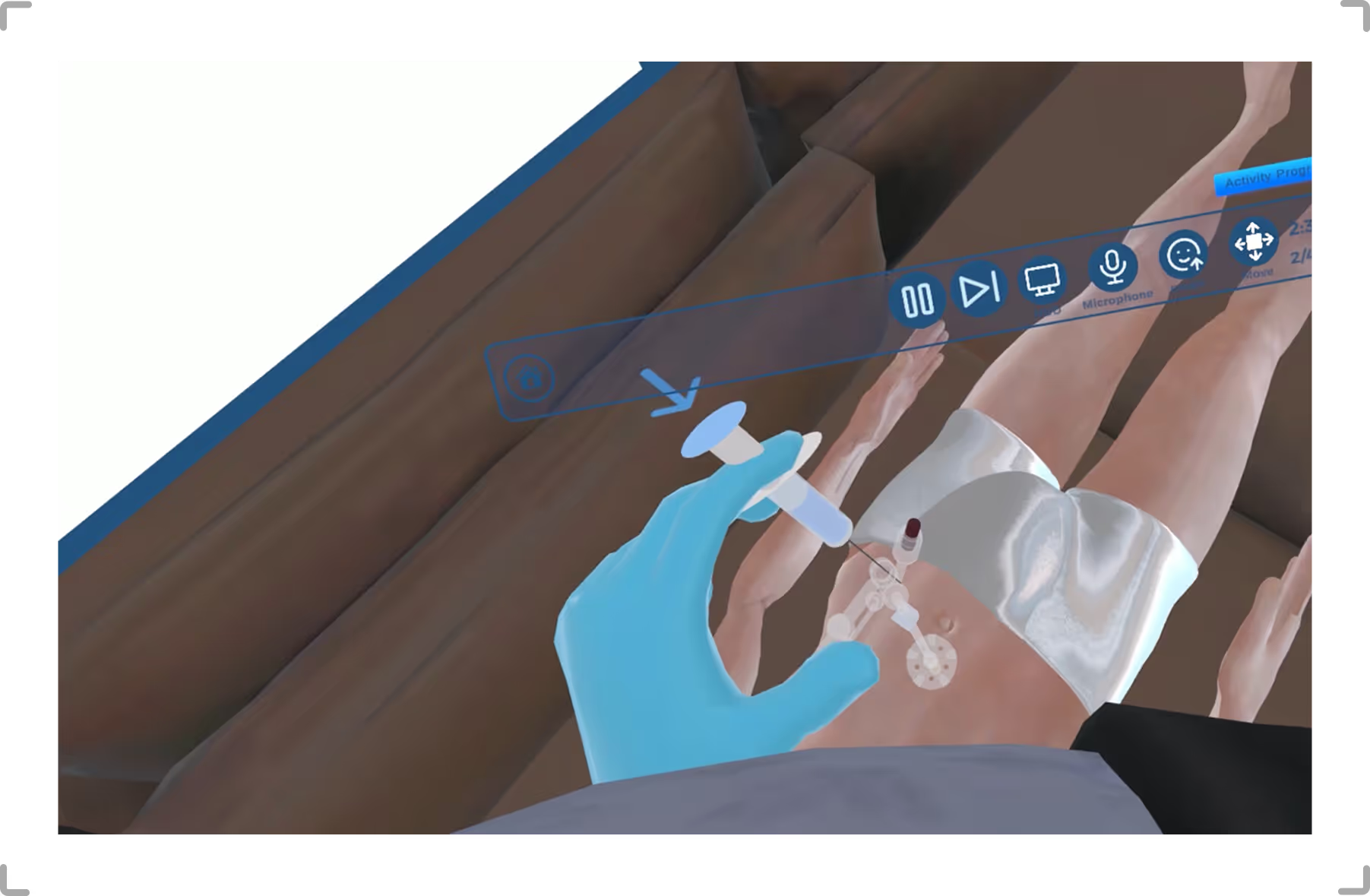
We develop and implement simulation and VR programs and platforms, integrating XR and AI to increase impact, expand reach, and enhance applications across health and healthcare.

Our Virtual Care Assistant (VCA) reduces documentation burden, care coordination challenges, and workforce capacity issues. It goes beyond ambient AI with a structured, workflow-aligned layer designed for managed care and home transitions teams, where coordination complexity and information gaps are most significant.

Our solutions are developed within established governance frameworks and deployed on HIPAA-compliant, secure cloud infrastructure, with enforced controls for privacy, security, auditability, and regulatory compliance.

We are dedicated to advancing clinical education, restoring clinicians' capacity, strengthening healthcare professionals’ resilience, and improving care delivery and patient outcomes.

Schedule an inaugural XR + AI workshop and experience how we co-design and innovate alongside our client partners.

Contact Us Today
" Innovation is not just about introducing new technologies but also about cultivating an environment where creative thinking and problem-solving thrive."
Ph.D., M.D., M.B.A, M.Sc, BSc(Hon)PharmMarnix E. Heersink Professor of Biomedical InnovationProfessor of MedicineAssistant Dean, School of MedicineExecutive Director, Heersink Institute for Biomedical InnovationChief Innovation Officer, UAB Health SystemUniversity of Alabama at BirminghamEditor in Chief, Innovation and Entrepreneurship in Health

-Dr. Rubin Pillay

https://rubinpillay.com/

Strategy. Governance. Performance.

Artificial Intelligence and Extended Reality are converging to transform how clinicians learn, decide, coordinate, and deliver care.

Guided by governance and anchored in institutional trust, this moment offers unprecedented opportunity to elevate education, restore workforce capacity, and strengthen patient outcomes at scale.

This is disciplined progress.

Clinical accuracy strengthened by intelligent systems.
Immersive education accelerating mastery and confidence.


Workforce capacity expanded through thoughtful automation.


Governance and innovation advancing together.


Outcomes improved through measurable performance.

Execution begins with strategy —

aligning executive leadership, clinical teams, educators, and governance stakeholders around a unified roadmap.


Oversight is embedded from inception — human-in-the-loop AI, accreditation-aligned education, and HIPAA-aligned infrastructure forming the structural foundation.


Impact is measured with precision — capacity restored, educational depth elevated, operational performance strengthened.The future of healthcare is immersive.
Intelligent.
Accountable.And it is ready to be built.

Built in collaboration with health systems, academic institutions, and clinical leaders.

Sean Moloney is the Founder of EmbodyXR, focused on addressing workforce strain, documentation burden, and the growing complexity of clinical education and care coordination. He builds enterprise platforms that integrate XR education, governed AI workflows, robotics, and clinical simulation to restore capacity and improve performance. His approach emphasizes real clinical workflows, institutional governance, and measurable outcomes across workforce, quality, and cost. Sean partners with health systems, academic institutions, and clinical leaders to deploy scalable solutions that modernize education, strengthen care coordination, and support responsible adoption of AI and emerging technologies.

John is Co-Founder of EmbodyXR and an expert in XR, VR, simulation, and AI, focused on AI governance, trust frameworks, and policy-aligned system design for healthcare. With over twenty years in XR, AR, VR, and game development, he builds clinically aligned platforms that integrate governed AI, simulation, and real-world healthcare workflows. His expertise includes secure architecture, guard proxy design, HIPAA-aligned environments, and EHR and LMS integration to support precision medicine. He develops XR and AI solutions that translate clinical data into actionable training and workforce performance tools, working closely with clinicians to align with real workflows and patient safety. He also trains XR and AI developers to build scalable, secure, and clinically grounded healthcare solutions.

CO-FOUNDER & ADVISOR FOR XR INNOVATION, PROGRAMS, AND COMPLIANCE Chief Innovation Officer of UAB Health System, Professor of Medicine, and Health Administration at UAB, and Executive Director of the Heersink Institute for Biomedical Innovation. Dr. Pillay has provided global leadership in healthcare innovation management and is a preeminent medical futurist. He has extensive experience transforming and innovating hospitals and healthcare systems globally.

Blending executive leadership with personal patient insight, Chris engages executives, clinicians, and frontline teams to position experience as a strategic driver of clinical, workforce, and financial performance. As Chief Experience Officer, he plays a critical role in identifying workflow improvements that inform the design and deployment of XR and AI solutions. He has held senior leadership roles at UAB Health System, Tanner Health System, Community Health Systems, Bon Secours, and BayCare Health System, leading enterprise transformation across operations, culture, and innovation to deliver measurable, system-wide impact at scale.

Emzon Shung brings financial discipline and operational rigor to EmbodyXR, ensuring innovation aligns with sustainable growth and measurable enterprise value. With expertise in financial strategy, planning, and performance management, he helps translate EmbodyXR’s XR, AI, and simulation capabilities into scalable, cost-effective solutions for healthcare organizations. His focus includes cost modeling, ROI validation, pricing strategy, and disciplined resource allocation to deliver both clinical and financial impact. Emzon partners closely with leadership to align product development, deployment, and partnerships with clear financial frameworks, enabling confident, transparent adoption of advanced technologies. His approach ensures EmbodyXR delivers innovation that is both technically advanced and financially sustainable at scale.

At UAB Medicine, he serves as Vice Chair for Clinical Affairs, advancing mental health care by integrating clinical research into practice and translating evidence into scalable care models. At the UAB Depression and Suicide Center, he leads research on novel treatments for severe and treatment-resistant mood disorders, contributing to national and international trials. In collaboration with EmbodyXR, he applies a human-centered approach to technology adoption, ensuring Virtual Care Assistants and AI workflows align with real clinical behavior, cognitive load, and team dynamics to improve workforce performance and patient care.

Dr. Bodduluri is the Director of AI programs at the Marnix E. Heersink Institute for Biomedical Innovation (MHIBI), overseeing the Graduate Certificate and MS in AI in Medicine degree programs at the Heersink School of Medicine. He also serves as the Assistant Professor of Medicine in Pulmonary, Allergy, and Critical Care and Director of AI research at UAB's Center for Lung Analytics and Imaging Research (CLAIR).  He also holds teaching appointments in Electrical and Computer Engineering. He obtained his MS and PhD in Biomedical Engineering from the University of Iowa.

Dorothy Ogdon is a technology strategist and librarian with a passion for opportunities driven by the evolution of information in the digital age. She is the Head of Emerging Technology and System Development in the University of Alabama at Birmingham Libraries. In this role, she leads technology integration and inquiry into how XR, 3D printing, and other leading-edge technologies can be used to evolve library services. She serves in an advisory role to groups at the university adopting XR, including the Marnix E. Heersink Institute for Biomedical Innovation and Professional Education in the Collat School of Business.  Ms. Ogdon is a Distinguished Member of the Medical Library Association’s Academy of Health Information Professionals.

Sean Moloney

Chief Executive Officer & Founder

John Tanha

Chief Technology Officer & Co-Founder

Dr. Rubin Pillay

Chief Medical Officer & Co-Founder

Chris Brainard

Chief Experience Officer

Matthew Macaluso, DO

Medical Extended Reality Advisor

Emzon Schung

Finance

Dorothy Ogdon

Information & Research Sciences

Sandeep Bodduluri

Artificial Intelligence (AI) Clinical Advisor

Team

Transforming Healthcare, Together

EmbodyXR is led by healthcare innovators, clinicians, technologists, and enterprise strategists committed to transforming how healthcare organizations educate clinicians, deploy trusted AI systems, and improve patient care outcomes.

AI + XR
Our Clinical Advisory Leadership Team
Our team and advisory partners bring deep clinical and operational expertise across healthcare delivery, education, and innovation. From the outset, they have shaped our approach, ensuring every solution is practical, scalable, and aligned with the realities and demands of modern health systems.

With experience spanning nursing leadership, physician education, simulation, and system transformation, this team enables healthcare organizations to move from strategy to execution with confidence, delivering solutions that strengthen clinical performance, build workforce capability, and produce measurable clinical, operational, and financial outcomes at scale.

Clinical Advisory Leadership Team

Jacob Vaughn
Director of Ambulatory Services UAB At Home - House Calls, UAB

Uabmedicine.org/housecalls
Matthew Macaluso
Behavioral Neurobiology

Heersink School of Medicine | The University of Alabama
Rubin Pillay
BSN-RN, AMB-BC

Clinical Development SpecialistUAB Medicine Department of Ambulatory ServicesUAB Medicine Human Resources | LearningAdvisor & Resident, UAB Medical SchoolNursing & Innovation @ UAB House Calls Medical Library Arts and Sciences

rubinpillay.com
Tacoa Ball
BSN- RN, AMB-BC

Clinical Development SpecialistUAB Medicine Department of Ambulatory ServicesUAB Medicine Human Resources | Learning
Ryan Doyle
BSN- RN, AMB-BC

Clinical Development SpecialistUAB Medicine Department of Ambulatory ServicesUAB Medicine Human Resources | Learning
Ronan O’Beirne
EdD, MBA

Division of Continuing Medical EducationUAB | The University of Alabama at Birmingham

uab.edu

BIBLIOGRAPHY

Our work is grounded in peer-reviewed research across augmented reality, virtual simulation, medical education, and healthcare systems innovation.

Foundational XR & Simulation Research

• Azuma, R. T. (1997). A survey of augmented reality.Presence: Teleoperators and Virtual Environments, 6(4), 355–385.

• Seymour, N. E., Gallagher, A. G., Roman, S. A., O’Brien, M. K., Bansal, V. K., & Andersen, D. K. (2002). Virtual reality training improves operating room performance: Results of a randomized, double-blinded study.Annals of Surgery, 236(4), 458–463.

• Chen, R., Lu, R., Zhang, T., & Wang, Q. (2020). COVID-19 prevention and control: Role of augmented reality simulation training in health care education.JMIR Medical Education, 6(2), e19637.

• Dankbaar, M. E., et al. (2014). Innovative virtual patients for clinical problem-solving training.Journal of Medical Internet Research, 16(3), e83.

• Diehl, L. A., et al. (2017). Systematic review of virtual reality in dental surgical training.Simulation in Healthcare, 12(1), 41–49.

• Chen, S., Reynolds, K., & Lin, C. (2019). Augmented reality applications for learning: A review of research.Journal of Educational Technology & Society, 22(2), 1–16.

Medical Education & Learning Science

• Batt-Rawden, S. A., et al. (2019). Teaching empathy to medical students: Systematic review.Academic Medicine, 94(6), 869–876.

• Carraccio, C., et al. (2016). Shifting paradigms: From Flexner to competencies.

• Harden, R. M., et al. (2017). AMEE Guide No. 135: Personalized academic and career guidance for medical students.

• Thistlethwaite, J., et al. (2017). Exploring interprofessional collaboration: The taught curriculum.

• Norman, G. (2016). Medical education: Past, present, and future.

• Silverman, J., et al. (2016). Teaching and learning communication skills in medicine.

• Papanagnou, D., et al. (2017). Virtual learning environment training for healthcare students: Systematic review.

CME & Healthcare System Gaps

• Davis, D., et al. (1992). Passive learning strategies and limited behavioral impact.

• Steinert, Y., et al. (2006). Lack of follow-up and feedback in CME.

• Cook, D. A., et al. (2014). Limited focus on clinical outcomes in CME.

• Curran, V. R., et al. (2012). Accessibility barriers to CME.

• Fox, R. D., et al. (2012). Stakeholder engagement gaps in program design.

• Hammick, M., et al. (2010). Limited accountability in CME.

• Mann, K., et al. (2009). Insufficient focus on quality improvement.

• Betancourt, J. R., et al. (2016). Cultural competence and health disparities.

Systems, Leadership & Innovation

• Ellaway, R., et al. (2019). Healthcare simulation technology: Where we’ve been, where we’re going.

• Kirschner, K. L., et al. (2019). Competencies for healthcare leaders in education systems.

• Scott, K. M., et al. (2016). Academic health centers and population health.

• 2023 XR Healthcare Adoption Survey
• 2023 XR Healthcare Equipment Report

• Smith et al. (2022). Collaborative workshops in medical education: A meta-analysis.

• Anderson et al. (2021). Integration of evidence-based practices in medical education.


Research Evidence Based.
Explore the Platform